
Instruments /Accessories / Ordering / Tips / Friends / Selling Your Guitar
Packing and Shipping
Shipping vintage guitars is not difficult. It just requires some easily available materials, and some common sense.
-First: get a shipping box made specifically for an acoustic guitar. Many music shops will be happy to give you a box from their recycling bin for free. Use a rectangular carton for dreadnought (D) size guitars or larger: most boxes from Gibson, Martin, Taylor, Guild etc. should be just fine. (Solid body or thinline electric guitars may be shipped in smaller cartons.) Don't try to use a bike, wardrobe, or appliance box, as it will cost you dearly in excess freight charges: commercial carriers calculate the shipping cost of guitars by the size of the parcel, rather than the actual weight.
You can buy sturdy, inexpensive guitar boxes here and here. Also, you can find secure, easy to use inflatable pads designed specifically for guitar shipping here as well, which we highly recommend for safe, no fuss packing. Otherwise, boxes and bubble wrap are also available from any shipping supply house, just Google "Shipping Room Supplies".
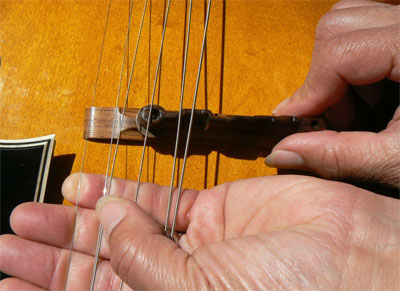
-Loosen the tuners just enough to slide the bridge out from under the strings. This simple step helps protect the soundboard from impact damage in transit. (Most archtop bridges are not permanently attached to the guitar, and are easily removed when the strings are slackened. Please leave bridges in place on solid body and thinline guitars.) Do not remove the strings from the tuners or the tailpiece. Finally, re-tighten the tuners just enough to pull the string ball ends securely into the tailpiece slots. This is important, as loose ball ends can damage the instrument finish in transit.
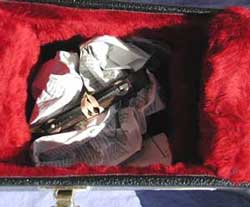
-Stow all loose parts in the accessory compartment. IMPORTANT: Please secure the two halves of the bridge together with a rubber band or blue painter's tape (no masking or Scotch tape please), and stow it in the accessory compartment of the case, under the lid that lies beneath the neck. If a removable pickup like a Dearmond is attached, please remove it before shipping. Finally, remove the end pin, which should be located at or near the tailpiece. Make sure no other objects like screws, cables etc. are loose in the case, as they can cause serious damage to the finish in transit.
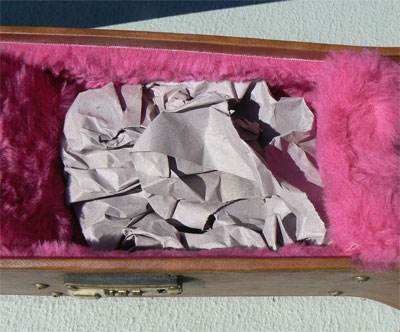
-Pack the accessory compartment. Use wadded paper to ensure that loose items won't escape into the case and damage the instrument in transit. Any items too large to fit safely in the case should be boxed separately within the shipping carton, with the words "Other Items Included" written clearly near the shipping label. Please note that to facilitate unpacking the carton, we will open your parcel from the bottom, and may miss extra items unless we are alerted to their presence
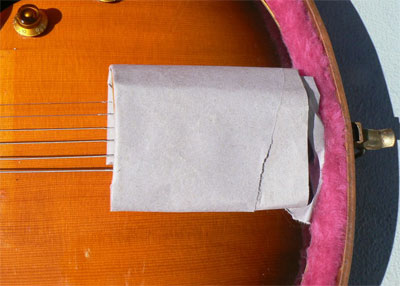
-Pad the tailpiece with folded paper to keep it from banging into the top and denting the finish. Avoid using tape when packing in general, as it can damage the finish on contact.
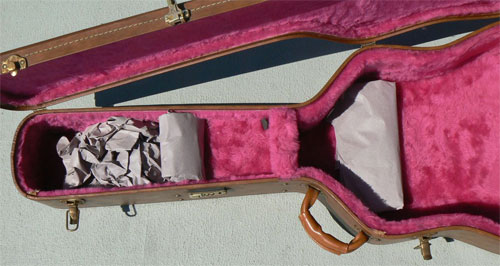
-Pad the case. Fold some paper to make a pad underneath the neck heel and shoulders of the guitar. This supports the body, so the neck does not bear all the weight of the instrument. Continue to equalize the load by securely padding the area under the peghead and neck as required. (Paper padding is recommended inside the case, as bubble wrap can adhere to the instrument finish in hot weather. Packing beads should never be used inside a guitar case.)
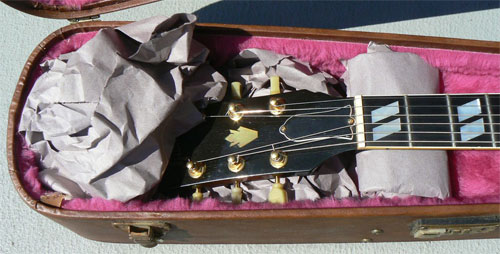
-Pad the peghead. Place the guitar in the case, and position another paper pad over and around the peghead as shown. This will help protect the head and neck against damage due to whiplash.
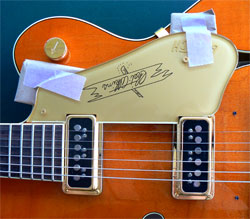
-Pad the pickguard, thoroughly. The pickguard is the most vulnerable part of the instrument to damage in transit, and must be padded at all points of connection to the guitar. Tuck small pieces of folded paper between the pickguard bracket and the soundboard, and under the guard at the neck, to protect both the guard and the top from impact damage in these sensitive areas. Then tape them in place with low tack painter's tape as shown, to keep them securely in place. If the guitar has a floating pickup, pad underneath the pickup, and under any controls mounted to the pickguard in a similar fashion. Please do not remove the pickguard from the instrument. Also there is no need to slip a sheet of paper under the strings on the pickguard, they both will be fine.
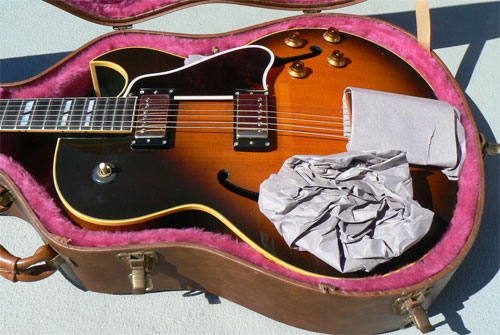
-Pad the soundboard. Wad a single piece of paper into a small pad about 6"-8" in diameter, with a single smooth side, as shown. To avoid scratching the finish, place the smooth side of the pad against the guitar top. Position the pad along the bass side of the soundboard, on the opposite side from the pickguard, as shown. Test your packing by closing the case lid: you should feel just enough gentle pressure to keep the guitar from rattling loose in the case. Be careful not to pack too tightly, as too much pressure on the guitar top can result in damage to the soundboard in transit.
Latch the case and shake it gently. If the guitar is still loose in the case, add padding until it is completely stabilized. Many older cases especially can fit the instrument quite loosely. On these, it is especially important to pad the tailblock area with some folded paper inserted between the endpin area and the case lining. Once again, please remember to remove the endpin if possible and stow it in the accessory compartment: it can act as a splitting wedge if the instrument is dropped on its tail in transit.
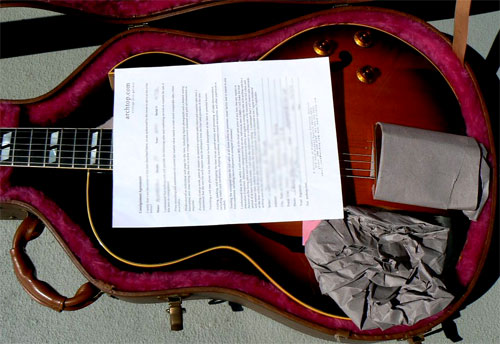
-Finally: put your completed consignment form in the *case*, not the box. We will unpack your parcel from the bottom, to facilitate removal of the guitar case. If you put your form anywhere other than in the guitar case itself, we may not find it at all. Please do not ship your instrument without a consignment form. This is important: it's how you get paid.
-Cushion the bottom of the guitar box with an inch or two of padding. Bubble wrap is best for this, but newspaper will do just fine. Lower the guitar case into the box, bottom (wide) end down.
-Fill the box. Use bubble wrap, cornstarch packing beads, kraft paper or wadded newspaper. For easy, secure packing we especially recommend the inflatable guitar shipping pads available here as well.
Please do not mix packing beads with newspaper or other recyclables. (It's a terrible mess to separate them, so please use one or the other only.) If you pack with newspaper, use a broom handle or short stick to tamp the padding down gently and evenly around the guitar case. We suggest extra packing on the top (soundboard) side of the guitar case, as it is the most vulnerable area to damage in transit. Do not pack too tightly, as your parcel needs a little flexibility to resist damage from compression in transit. Before sealing the box, check it by shaking it to make sure the case doesn't rattle around in the box. Add more padding if necessary until the case is firmly stabilized.
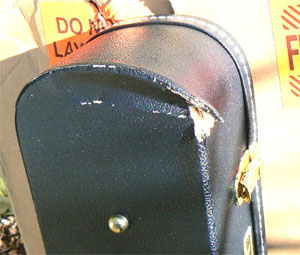
Needless to say, stringed instruments must never be shipped without a case. Here's why. The photo at left is a closeup of a parcel received by us some years ago. The parcel handlers managed to pierce the shipping carton (in background) and crush the new hardshell case inside, smashing all 5 wooden plies of the case shell right at the peghead. However, the instrument inside, with replacement value of $7500, emerged unscathed. Had this instrument been shipped without a hardshell case, the headstock would have snapped like a matchstick, and we'd be sweeping up a nicely lacquered pile of kindling.
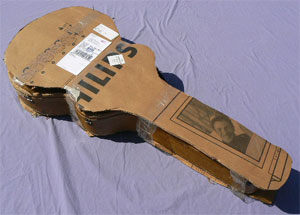
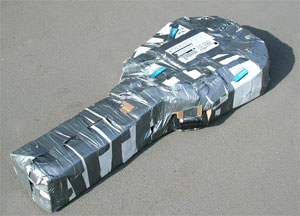
If for any reason, the instrument is lacking a hardshell case, or a good rigid foam gig bag, it should be double boxed, using an inner box inside the main container. Shippers will not accept or pay damage claims on instruments shipped without a solid case or double boxing. Finally, please do not try to make your own box, as it can be ruinous to your delicate instrument. (See bad examples, below.)
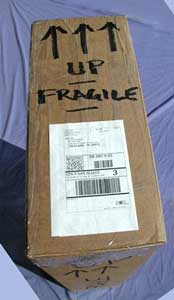
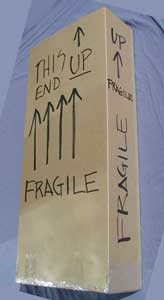 -Tape the top and bottom flaps securely. Make sure to write your name and address, and ours elsewhere on the parcel with a marking pen as well. Finally, draw some long arrows along the four long sides of the box, pointing up toward the top lid, with the words "Fragile: This End Up".
-Ship the parcel. Drop the parcel off at any location that offers pickup services for your carrier.
-You're done. If you follow these instructions, you will maximize the safety of your parcel, and minimize the cost and transit time.
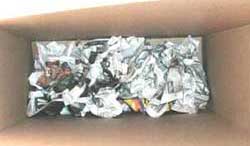
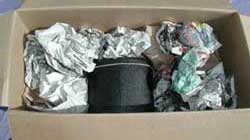
Finally, here are two actual "parcels" we have received, textbook examples of how never to pack a guitar. Miraculously, both of these ludicrously packaged instruments actually arrived undamaged, which can only be proof that the Good Lord has an excellent sense of humor. If you are tempted to try any similar stunt, run, don't walk to your nearest UPS Store or Kinkos and they will pack it for you. Thanks, and may the Parcel Gods be with you.
Instruments /Accessories / Ordering / Tips / Friends / Selling Your Guitar